Canning Bridge Rail Station Precinct Study and Vision
The Canning Bridge Precinct Vision was developed in response to State planning strategies aimed at accommodating population growth and was endorsed by the Councils of the Cities of South Perth and Melville, and subsequently by the Western Australian Planning Commission (WAPC), in 2010.
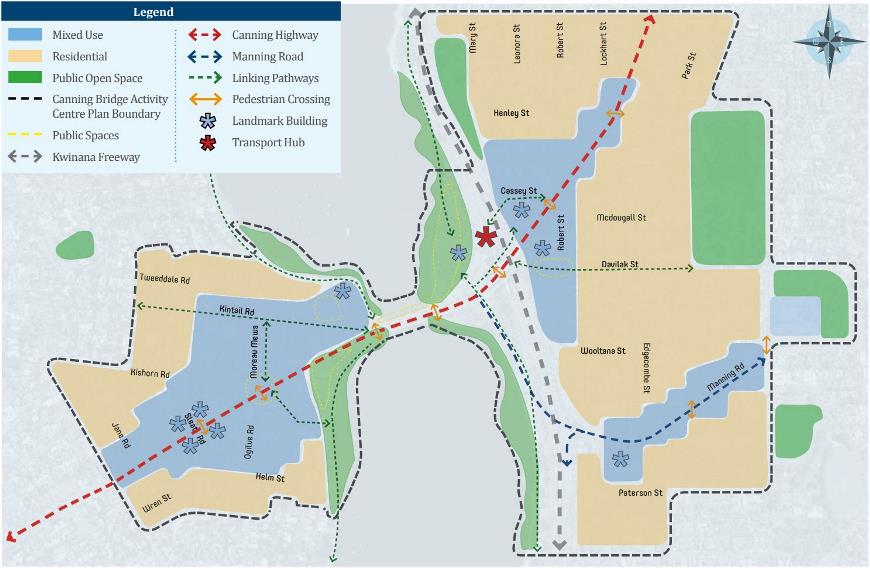
Initiated by the City of South Perth in 2006, the planning process examined opportunities to accommodate a diverse mix of land uses, housing and employment around the Canning Bridge Station precinct, capitalising on its role as a major public transport hub linking the Perth-Mandurah rail line and key east-west bus routes. The study area extended approximately 800 metres from the station, representing a ten-minute walk catchment.
The resulting Canning Bridge Rail Station Precinct Study was undertaken in partnership with the WAPC and the City of Melville and led to the endorsement of the Canning Bridge Precinct Vision as the preferred framework for future development.
A multi-agency working group was subsequently established to oversee its implementation. The Vision received the 2011 Planning Institute of Australia (WA) Award for Excellence for Best Large Project in recognition of its approach to activity centre regeneration and transit-oriented development.
Public Transport
Canning Bridge Station is located within the City of South Perth, directly under the Canning Highway Bridge and within the Kwinana Freeway reserve. It is the first station south of the Perth CBD with the location highly valued as a transfer point as the nexus of the Perth to Mandurah railway and major east-west bus routes. The rail station site is constrained by the relatively narrow Kwinana Freeway reserve, which limits opportunities for associated urban development in close proximity to the station.
The Canning Bus Bridge Interchange has been identified for upgrade and expansion to meet the requirements of existing and future passengers. Information on works is available on the Department of Transport’s website including a preliminary design which focusses on ensuring the bus interchange and road/path improvements work together to provide essential upgrades for bus, road and path users.